
How DSS Technology Works
Discover the step-by-step chemo-mechanical process that transforms worn friction surfaces into smooth, highly durable metal-ceramic layers.

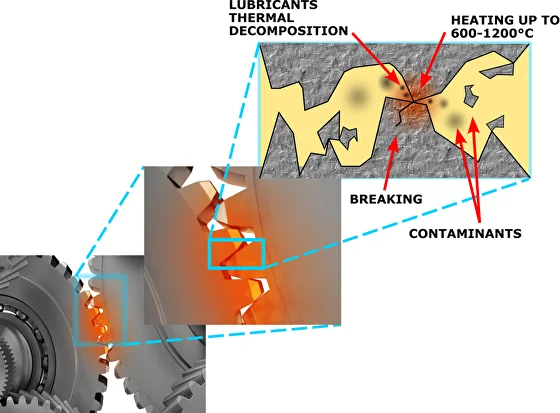
Pre-Treatment Wear and RSM Activation
DSS uses micro-level physical processes—such as heating and fracturing of friction-affected surfaces—to activate special substances (RSMs), which then react with the materials of the interacting components.
Before applying RSM, friction surfaces gradually deteriorate, releasing microparticles that contaminate the lubricants. High-temperature zones also form, causing the lubricants to degrade and lose their functional properties.
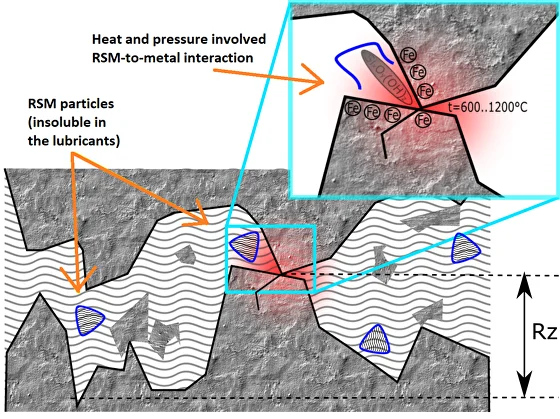
Chemo-Mechanical Surface Smoothing
After RSM is introduced into the lubricants, a chemo-mechanical process begins in the high-temperature zones, cleaning and smoothing the friction surfaces.
A monocrystalline layer begins to build up on the component surfaces, with the growth process naturally self-regulating for optimal performance.
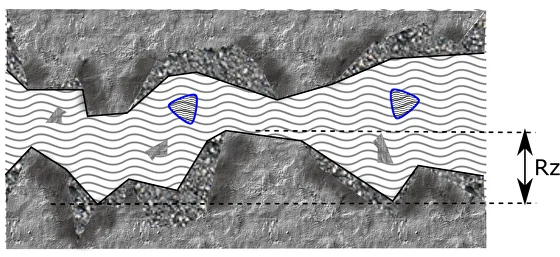
Expanding Contact Area and Distributing Load
DSS transforms the surfaces in high-friction zones, reducing their roughness. As a result, both the number of high-temperature areas and the amount of lubricant contamination gradually decrease.
With the reduction of surface roughness, the contact area between the components expands, resulting in a more uniform distribution of the load.
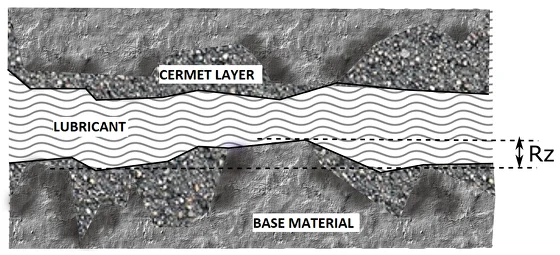
Permanent Wear and Energy Reduction
Once the surface transformation is complete, the lubricants contain no remaining RSM, and only the friction surfaces are coated with a smooth, highly durable metal-ceramic layer, not just film. This layer never flakes off the detail, and significantly reduces frictional energy losses and decreases wear on both the components and the lubricants.
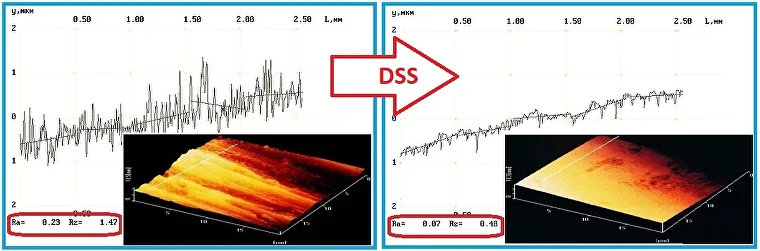
Profilogram Results and Analysis
Profilogram measurements (Ra and Rz) show that DSS reduces the roughness of the surface layer by a factor of three after the RSM interacts with the component surfaces.